
How AI Is Changing Game Development and What It Means for Players in 2026. Artificial intelligence is no longer a futuristic concept in gaming. In 2026, AI is actively reshaping how games are designed, built, tested, and experienced. From smarter non-playable characters to faster development pipelines and more personalized gameplay, AI in game development is becoming one of the biggest forces behind the industry’s evolution.
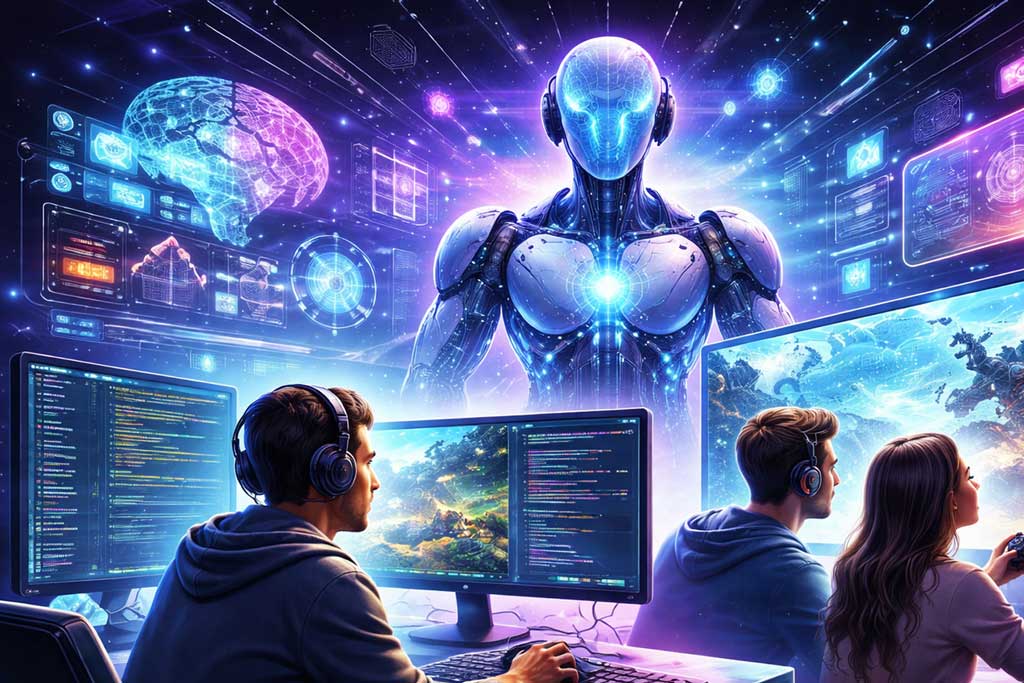
For players, that means richer worlds, more realistic interactions, and games that feel more responsive than ever before. For studios, it means new tools, greater efficiency, and fresh opportunities to innovate. In this article, we’ll explore how AI is changing game development and what it means for players in 2026.
The Growing Role of AI in Game Development
AI has been part of gaming for years, especially in enemy behavior and pathfinding. What’s different in 2026 is the scale and sophistication of its use. Developers are now using AI throughout the entire production cycle, not just inside the game itself.
Modern game studios rely on AI to assist with:
- Procedural content generation
- Character animation and motion refinement
- Dialogue creation and localization
- Quality assurance testing
- Player behavior analysis
- Dynamic difficulty balancing
These tools are helping teams create larger, more complex games without increasing development time at the same pace. As a result, both indie developers and major studios can build more immersive experiences with fewer repetitive manual tasks.
Smarter NPCs and More Believable Game Worlds
One of the most noticeable impacts of AI in gaming is the improvement of NPC behavior. In older games, non-playable characters often followed rigid scripts or predictable routines. In 2026, AI allows NPCs to respond more naturally to player actions, environmental changes, and evolving story events.
NPCs That Adapt in Real Time
Instead of repeating the same dialogue or making the same decisions every time, AI-driven NPCs can now adapt their behavior based on context. They may remember prior interactions, change their tone, or react differently depending on how the player has behaved.
This makes game worlds feel more alive. Whether it’s an ally responding to your moral choices or an enemy adjusting its tactics during combat, AI is helping interactions feel less mechanical and more organic.
Better Enemy Intelligence
Enemy AI has also become more advanced. Rather than simply attacking in patterns, opponents can coordinate, flank, retreat, or learn from player strategies. This creates more engaging gameplay and reduces the sense that players are exploiting predictable systems.
For competitive and action-based games, better enemy intelligence means more satisfying challenges and less repetitive combat.
AI Is Speeding Up Game Production
Game development has become increasingly expensive and time-consuming. AI is helping solve that problem by automating parts of the workflow and allowing developers to focus on creativity and design.
Faster Asset Creation
AI-assisted tools can help generate textures, voice drafts, environment concepts, and animation variations. Artists and designers still guide the creative vision, but AI can reduce the time spent on repetitive tasks.
This is especially valuable for smaller teams. Indie studios that once struggled with limited resources can now produce more polished games and larger worlds with AI support.
Improved Testing and Bug Detection
Quality assurance is another area where AI is making a major difference. AI bots can run through levels, test systems, identify crashes, and spot gameplay inconsistencies much faster than traditional manual testing alone.
This doesn’t replace human testers, but it gives teams a better way to catch bugs early. The result for players is a smoother launch experience, fewer game-breaking issues, and quicker patches after release.
Personalized Gaming Experiences for Players
In 2026, one of the biggest benefits of AI for players is personalization. Games can now adapt more intelligently to individual play styles, skill levels, and preferences.
Dynamic Difficulty and Adaptive Gameplay
AI can analyze how a player approaches a game and adjust the experience accordingly. If a player is struggling, the game may subtly reduce difficulty or provide hints. If they are dominating, it may introduce smarter enemies or more complex scenarios.
This helps games remain fun and balanced for a wider range of players. It also reduces frustration for newcomers while keeping experienced gamers engaged.
Customized Storytelling and Player Choice
Some games are using AI to support more flexible narratives. Instead of offering only a few branching paths, AI can help generate dialogue variations, side quests, and character responses that feel tailored to the player’s decisions.
While fully AI-generated storytelling is still evolving, the technology is already making interactive narratives feel deeper and more responsive.
What AI Means for Multiplayer and Live Service Games
AI is also changing how online games are managed and updated. Live service titles in particular benefit from AI-driven systems that monitor player behavior, balance economies, and improve moderation.
Better Matchmaking and Community Management
AI can create fairer matchmaking by analyzing skill levels, play habits, and team dynamics with greater accuracy. This leads to more balanced matches and a better overall player experience.
It also helps identify toxic behavior, cheating patterns, and suspicious activity faster than manual moderation alone. For players, that means safer and more enjoyable online communities.
Smarter Live Updates
Developers can use AI to analyze player engagement, identify where users drop off, and understand which features are working. This allows studios to make smarter content updates, improve retention, and respond quickly to community needs.
In practical terms, players get games that evolve more effectively over time.
Concerns Around AI in Gaming
Despite the benefits, AI in game development also raises important concerns. Some players and developers worry about over-automation, creative authenticity, and job displacement.
There are also questions about data privacy, especially when AI systems rely on player behavior data to personalize experiences. Transparency will be increasingly important as studios use these tools more widely.
Another concern is quality control. AI-generated content can be impressive, but it still needs human oversight. Without strong creative direction, games risk feeling generic or inconsistent.
The best outcomes usually come when AI supports developers rather than replacing them. Human creativity remains essential for memorable design, emotional storytelling, and artistic originality.
The Future of AI in Gaming in 2026 and Beyond
AI is not replacing game developers or players. Instead, it is becoming a powerful tool that enhances both game creation and gameplay. In 2026, the biggest changes are already visible: smarter NPCs, faster development, better testing, personalized experiences, and improved live service support.
For players, this means more immersive, dynamic, and accessible games. For developers, it opens the door to faster innovation and more ambitious ideas.
As AI technology continues to evolve, gaming will likely become even more interactive and responsive. The studios that use AI thoughtfully will be best positioned to create memorable experiences that still feel human at their core.
Final Thoughts
AI is changing game development in ways that were hard to imagine just a few years ago. It is helping studios build better games faster while giving players worlds that feel more intelligent and alive.
In 2026, the impact of AI on gaming is no longer theoretical. It is already shaping the games people play every day. As long as developers balance automation with creativity, AI could lead to one of the most exciting eras in gaming history.
